
The Skills AI Can't Replace: Why Your Team Needs Artistry, Not Methodology
“Consulting is dead.”
We keep hearing this. Last week, we watched another firm give up on consulting and pivot to selling online courses.
Fair enough.
Some types of consulting deserve to end. The kind where you follow a script. Where the problem is clear, the tasks repeat, the method comes from a textbook, and AI can now do it faster and cheaper than a room full of junior analysts.
Selling scrum masters. Running playbook engagements. Deploying a methodology someone picked up at a two-day certification.
That work is moving in-house. Let it.
But there’s another kind of work
We call it artistry.
Artistry is what happens when no one has solved the problem before. When the real issue lives between people, between teams, between what the strategy says and what the culture allows. It’s sitting with a CEO as a peer and having the conversation no one else will have. Helping a leader make a call when the facts are murky and the stakes are high. Seeing a whole system, then making sense of it for the people stuck inside it.
That takes judgment. Presence. Someone who can hold a mess and not flinch.
You can’t package that into a course. You can’t automate it.
The research agrees
Harvard Business School’s AI outlook for 2026 was blunt: as AI absorbs analytical and modelling tasks, differentiation shifts to human judgment, insight, and the ability to build real relationships. AI can process information. It can’t sense the room.
McKinsey’s global managing partner told HBR the firm is accelerating its move toward outcomes-based work, blending human judgment with AI agents. Even the world’s biggest consulting firm sees where value is heading.
And in an article by Atlassian, across the industry, the old consulting pyramid, a broad base of data collectors supporting a narrow tier of decision-makers, is collapsing. The base gets thinner. The human layer on top gets heavier.
Value is moving toward judgment, alignment, and problems with no playbook.
This applies inside your organisation too
We’re talking about consulting. But the same shift is happening in every team, every department, every leadership group.
One question matters: are we building the right skills in our people?
The skills that count most now are the ones no course fully teaches. Solving problems when the answer is unclear. Making good calls under pressure. Seeing the whole system, not just the parts.
These are artistry skills. They grow through practice, mentorship, and real exposure to hard, human, messy work.
Your best people already have some of this. The question is whether you’re growing it, or still spending your development budget on methodologies AI will handle next year.
Commodity vs artistry: a simple test
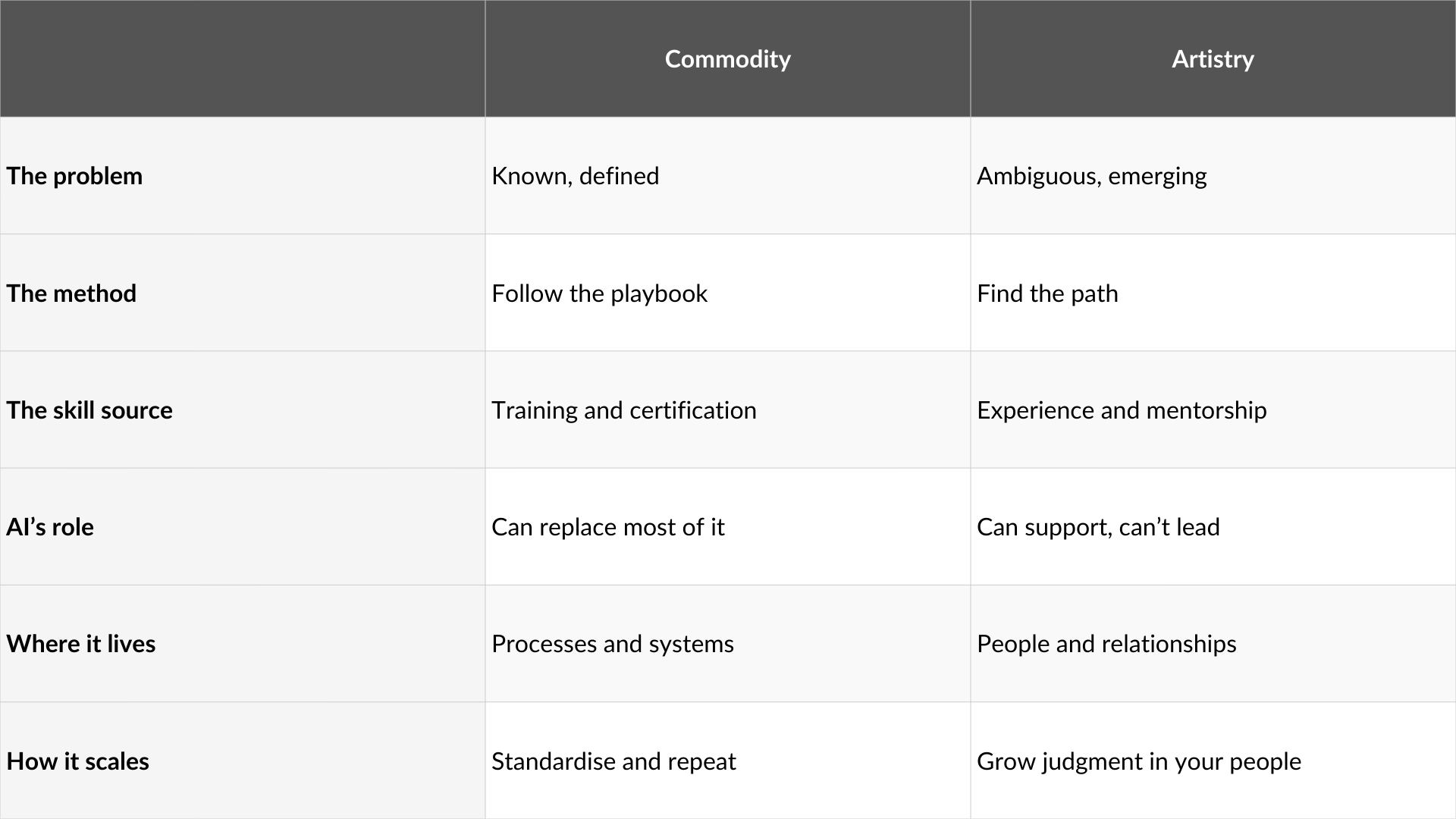
Here’s one way to think about it. Every capability in your organisation sits somewhere on this spectrum.
Commodity work is clear, repeatable, and teachable. The problem is known. The method is proven. Someone wrote a playbook. AI can do most of it now, and what AI can’t do, a smart junior hire can learn in weeks.
Artistry work is ambiguous, human, and contextual. The problem is tangled. The answer depends on relationships, timing, culture, and things no one has written down. It requires judgment built through years of practice, not a course completed last Tuesday.
Most organisations invest heavily in the left column. Training programs. Certifications. Frameworks. That made sense when commodity skills were hard to find.
That bottleneck has moved.
The real question
Some consulting needs to end. Good.
But work that requires judgment, presence, and the ability to hold complexity? That’s growing. Inside firms. Inside organisations. Everywhere the problems are human and the stakes are real.
How are you creating more artistry in your teams?
At Neu21, we help organisations build the capabilities that matter most in the AI era. If you’re rethinking how your teams solve complex, human problems, we should talk.
References
1. AI Trends for 2026: Building ‘Change Fitness’ and Balancing Trade-Offs — Harvard Business School Working Knowledge
2. McKinsey Faces Its AI Future — Harvard Business Review
3. The Consulting Industry’s Human-Powered Renaissance — Atlassian Work Life
4. How Do Workers Develop Good Judgment in the AI Era? — Harvard Business Review