
Why Your Organisation Has Too Many Meetings (And How To Fix It)
A client asked us recently: how do we cut down the number of meetings around here?
You know the feeling. You open your calendar on Monday morning and there's barely a gap. By Wednesday you're doing your actual work at 7pm because the day was wall-to-wall meetings, half of which could have been an email. Atlassian found that 78% of workers say they attend so many meetings that getting real work done becomes difficult, and over half are working overtime just to compensate. For directors and above, that number climbs to 67%.
The instinct is to reach for calendar fixes: shorter slots, meeting-free Fridays, new booking rules. Those things help at the edges, but they wear off fast because they treat the symptom. The causes live somewhere else.
What's actually driving the overload
We've seen this pattern across organisations. Meeting bloat almost always traces back to three root causes.
Goals are unclear. When teams don't know what they're trying to achieve, or where one team's work ends and another's begins, meetings fill the gap. Every ambiguity generates a meeting, and every overlap between teams generates two.
Roles are fuzzy. When nobody’s sure who owns what, everyone shows up to everything just in case. That's how you end up with twelve people in a room where three would do.
Not feeling empowered. When people don’t feel that they’re able to make decisions on their own, they default to creating check-in meetings, status updates, and oversight rituals. As a result, you’re stuck with more meetings than action.
And then there's scale. Large organisations just have more people, more teams, more moving parts. That's reality, and it's fine. More coordination is an inevitable outcome of growth. You accept it but you can design for it.
Here’s how.
Set the rhythms before the meetings start
Now whilst we want to ideally address the root causes, but there is still the need for good practice, which most organisations fall short. They let meetings emerge organically. Someone needs something, they book it in. Multiply that by hundreds of people and you get calendar chaos.
How you address this is upstream by setting deliberate rhythms for how information flows, before anyone opens a calendar.
For project work, that means knowing your stakeholders. Who needs to be involved? Who just needs updates? How much do they need to know, and how often? Map that out, then design the right type of meeting for each group. A monthly steering committee for sponsors, a fortnightly sync for the core team, a short discovery session for a specific problem, a risk review when things shift.
For BAU work, the same principle applies. Regular standups, team check-ins, and planning sessions might look different from project ceremonies, but the logic is identical: define the cadence so people know when and how they'll hear what they need.
When you get this right across both project and BAU, you create a heartbeat. Information flows at a predictable pace, people stop guessing, and the reactive ad-hoc meetings that clog calendars start to disappear on their own.
Flowtrace analysed over two million meetings and found that 64% of recurring meetings had no structured agenda. Those meetings exist because someone felt uncertain, and a clear rhythm would have caught that uncertainty before it became a calendar invite.
What would your calendar look like if every meeting was planned into a rhythm, rather than reacting to whatever felt urgent that week?
Five things you can do right now
Building rhythms takes time. And we do appreciate that sometimes you need to just make some progress, so here are five moves which create space while you work on the upstream fix.
1. Every meeting needs a stated goal.Before you send an invite, write one sentence about what this meeting is trying to achieve. That alone forces the organiser to think about who actually needs to be there, and it gives invitees the information to opt out. Fellow found that 72% of professionals say clear objectives are the key to effective meetings, yet only 37% of meetings actually use an agenda.
What would change if every invite in your organisation had a one-sentence purpose?
2. Give people permission to decline.This one is cultural. Most people go to meetings because they're on the calendar, not because they know why they're there. Create an environment where saying "I don't think I need to be in this one." is genuinely welcomed. Model it yourself, and celebrate it when others do it. The discomfort fades fast when people see that declining is respected.
How many meetings on your calendar this week would you skip if you felt genuinely free to?
3. Play with meeting lengths.Stop defaulting to 60 minutes, or even 30. Could it be 15? Could you do 45? That missing 15 minutes adds up fast when you multiply it by every person in the meeting, across every meeting in a week. Only 5.4% of meetings are auto-shortened to 25 or 50 minutes. Almost everyone is still running on default settings.
4. Batch meetings into dedicated days.
Stack your meetings onto specific days so that the remaining days stay clear for deep focus work. When meeting time is visibly scarce, people start asking better questions about whether this meeting really needs to happen. There's predictability, people can prepare, and the open days are protected.
5. Use other channels for one-way information.If you're broadcasting information, a meeting is probably the wrong format. A voice note, a short recording, a shared document, or a Slack update lets someone consume what they need in their own time, at double speed if they want. That's faster than blocking 30 minutes on eight people's calendars. Save synchronous time for things that actually need a live conversation: decisions, debates, and genuine collaboration.
When was the last time you turned a meeting into a three-minute voice note instead?
Reactive vs intentional: a simple diagnostic
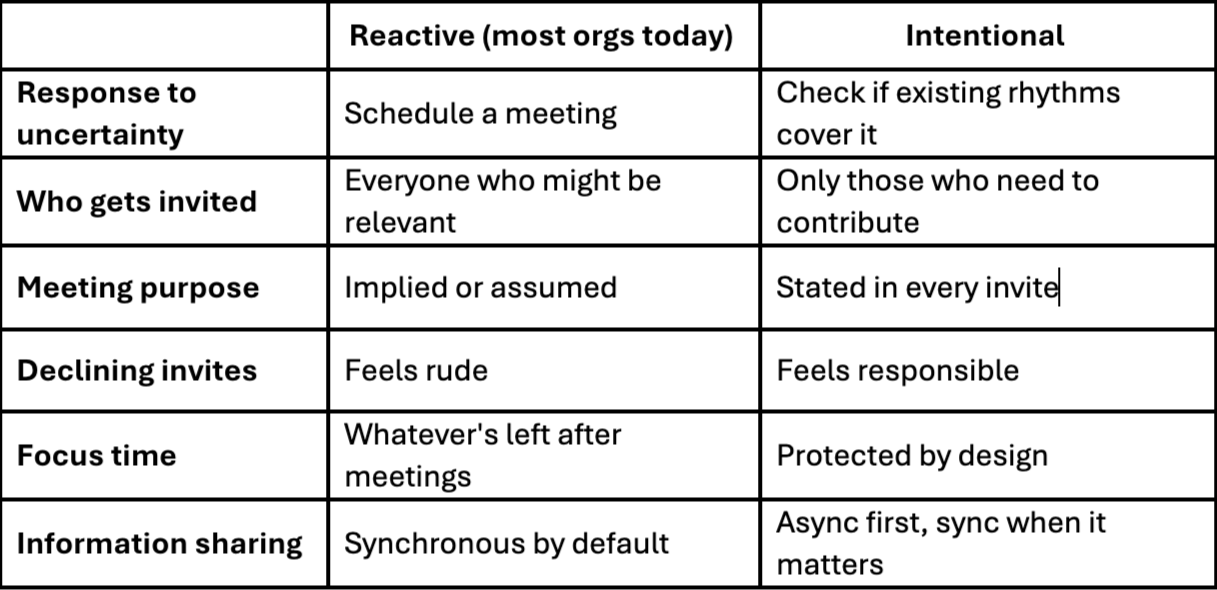
Where does your organisation sit on this table right now?
Good meetings earn their place
Meetings matter. They're where alignment happens, decisions land, and relationships form. We’re not trying to get rid of meetings entirely, the goal is for each of them to earn its spot on the calendar.
Microsoft's research found that employees face an interruption every two minutes during core work hours, adding up to 275 interruptions a day. Every unnecessary meeting adds to that load, and every one you remove gives someone the space to think clearly and do their best work.
Start with the rhythms, build them for both project work and BAU, and then sharpen the tactics around them. In parallel, look into the root causes. The organisations that get this right don't just have fewer meetings. They have better ones.
At Neu21, we help organisations redesign how work flows. If your team is drowning in meetings and struggling to find focus time, we should talk.
References
Workplace Woes: Meetings, Atlassian
100 Surprising Meeting Statistics for 2026, Flowtrace
Meeting Fatigue Statistics 2026, Speakwise
Microsoft Work Trend Index 2025, Microsoft